
What Makes Tyres Illegal in the UK?
You walk back to the car and something about the front tyre looks wrong. Maybe the tread seems thin, or the tyre pressure light has just come on, or your last MOT came back with an advisory you never acted on. Then comes the question: are these tyres actually legal?
Here is the short answer to what makes tyres illegal in the UK. A tyre breaks the law when its tread falls below 1.6mm across the central three-quarters of its width, when it carries serious damage such as a deep cut or a bulge, or when it’s the wrong size, type or rating for your car. Running it badly under-inflated counts too. Below, we cover each rule, how to check your own tyres in five minutes, and what getting caught really costs.
What Is a Legal Tyre?
A road-legal tyre has to meet four requirements at once. Failing any one of them is enough to make it illegal.
The rules come from the Road Vehicles (Construction and Use) Regulations 1986. The penalties sit under the Road Traffic Act 1988.
What Makes Your Tyres Illegal?
This isn’t a rare problem. A tyre specialist recently warned that 6.1 million tyres on UK roads are illegal. Six faults account for nearly every tyre that fails a roadside check or an MOT. If any of these describes one of your tyres, it isn’t road legal today.
1. Tread below 1.6mm
This is the one most people know. Measure in the main grooves across the middle three-quarters of the tread. One worn patch is enough, so a tyre with plenty of depth on the outside but a bald strip in the middle still fails. Uneven wear like this is common when tracking is out or pressures are wrong.
2. Cuts, bulges, blisters and exposed cords
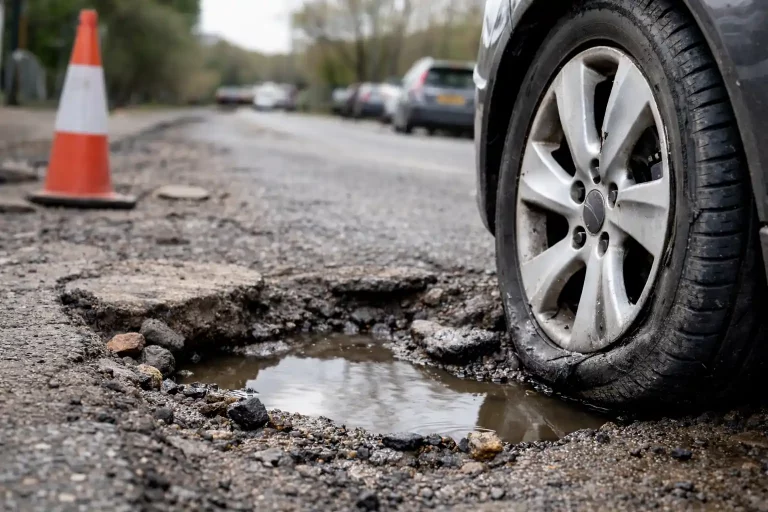
A cut longer than 25mm, or 10% of the tyre’s section width if that’s greater, is illegal once it’s deep enough to reach the ply or cord. Any lump, bulge or tear caused by the internal structure separating makes a tyre illegal outright, however small it looks. So does visible cord or ply anywhere on the tread or sidewall. Bulges usually follow a hard knock against a kerb or pothole, and they can fail without warning.
3. Wrong size or mismatched types
Tyres on the same axle must be the same size and the same construction. Radial and cross-ply tyres must never share an axle. Fitting a tyre the car wasn’t designed for, or pairing two very different tyres side by side, can also upset braking and stability systems that rely on both wheels behaving alike.
4. Load index or speed rating too low
Every tyre carries a load index and speed rating on the sidewall. A load index lower than your car requires means the tyre isn’t fit for the weight it carries. A speed rating below the vehicle’s specification is also a problem, and it can cause trouble with your insurer. Your handbook lists the minimum ratings.
5. Serious under- or over-inflation
The 1986 Regulations require a tyre to be inflated to suit its use. Driving on a tyre that’s visibly flat or far off the recommended pressure is an offence, and it also wears the shoulders or centre out quickly, leading straight back to fault number one.
6. Part-worn tyres that break the selling rules
Second-hand tyres are legal to sell and fit, but the Motor Vehicle Tyres (Safety) Regulations 1994 set conditions. The tyre needs at least 2mm of tread across its full width, and the sidewall must carry a permanent “PART-WORN” mark. One without the stamp, or with less tread, shouldn’t have been sold to you.
Illegal Tyre Examples: Does Yours Look Like This?
Words only go so far. These are the faults our fitters see most often at the kerbside, each one illegal or close to it.


Not sure which one you’re looking at? Book a tyre check and we’ll tell you straight.
How to Check If Your Tyres Are Legal
Five minutes on the driveway once a month will catch most problems before the police or an MOT tester does. Do these checks in order.
While you’re down there, run your eyes along both sidewalls for cuts, lumps and cracking, and turn the steering to full lock so you can see the inner edge of the front tyres. Check monthly, and always before a long trip.
Replacing at 3mm is advice, not law. Tests by tyre makers show stopping distances in the wet lengthen as tread wears, so many fitters recommend changing before you reach 1.6mm. The legal limit stays at 1.6mm.
Tyre Age: Are 10-Year-Old Tyres Illegal?
No. UK law sets no maximum age for car tyres. A ten-year-old tyre with good tread and no damage is technically legal. Age still matters, though, because rubber hardens and cracks over time even when the car isn’t moving.
To find a tyre’s age, look for “DOT” on the sidewall followed by a string of characters. The last four digits are the date: the first two are the week of manufacture, the last two the year. A code ending 2319 means the 23rd week of 2019.
Our rule of thumb: have tyres inspected closely from five to six years old, and replace them within ten years whatever the tread looks like. Don’t forget the spare, which often outlives every other tyre on the car.
Age catches out plenty of drivers in Kent. Caravans and trailers that spend most of the year parked near the coast can show good tread on tyres that are cracking with age. At the other end of the scale, cars and vans clocking up miles to and from Dover port wear through tread far faster than average. Both deserve a closer look.
The Penalties: Fines, Points, MOT and Insurance
Defective tyres are taken seriously because each one is treated as a separate offence, so the penalties stack up quickly. The maximum penalty is a fine of up to £2,500 and 3 penalty points per tyre, under the Road Traffic Act 1988 and the Road Vehicles (Construction and Use) Regulations 1986.
| Illegal tyres | Maximum fine | Penalty points | What it means |
|---|---|---|---|
| 1 | Up to £2,500 | 3 | A fine and an endorsement on your licence |
| 2 | Up to £5,000 | 6 | Licence revoked for drivers within two years of passing their test |
| 3 | Up to £7,500 | 9 | One more offence could see you banned |
| 4 | Up to £10,000 | 12 | Enough points for a driving ban |
Can You Legally Drive to a Garage on Illegal Tyres?
No. The law doesn’t make an exception for the trip to the tyre shop. An illegal tyre is illegal on every journey, including the five-minute drive to have it replaced, and a bulging or corded tyre could fail on the way.
This is exactly why mobile tyre fitting exists. Illegal tyres can’t legally be driven to a garage, so we come to you. Our van carries the tyres, the fitting kit and the balancing equipment, and we replace the tyre on your drive, at work or in a car park.
If you’ve just found a problem, leave the car where it is and call us. Find out more about our mobile tyre fitting service across Kent , or go straight to booking a tyre replacement.