
Tyre Checks to Do Before Your Ferry from Dover
A quick check at home now saves a stressful wait in the port queue later. Here’s what our Dover fitters look at first.
Before You Head for the Port
A ten-minute tyre check at home is the cheapest insurance you’ll buy for a trip to France. Once you’re through check-in at the Port of Dover or queuing for Le Shuttle, a soft or damaged tyre becomes a much bigger problem than it would have been on your own drive.
We see it most weeks. A car packed to the roof, a slow puncture nobody noticed, and a family watching their sailing time creep closer. As a team that fits tyres in Dover every day, here’s what we’d check before setting off, and what to do if something goes wrong on the way.
Five Tyre Checks to Do Before You Leave Home
Do these a day or two before you travel, not on the morning of the crossing. That leaves time to sort anything you find.
Tread depth. The legal minimum in both the UK and France is 1.6mm across the central three-quarters of the tyre. Push a 20p coin into the main grooves: if the outer band disappears, you’re comfortably above the limit. If you can see it, get the tyres checked before a long motorway run.
Pressures, measured cold. Check before you drive anywhere, using the figures on the sticker inside the driver’s door or fuel flap. Most cars list a higher pressure for a full load, and that’s the one you want for a holiday trip.
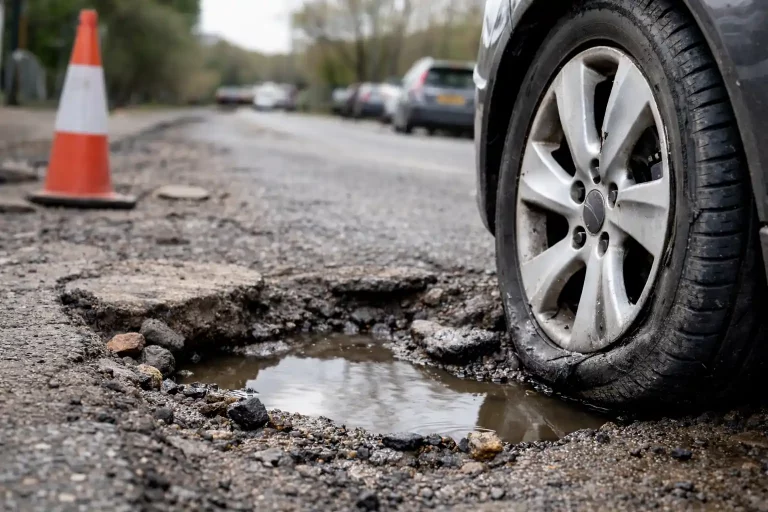
Bulges, cuts and nails. Run your hand and eye around each sidewall. A bulge means internal damage and the tyre needs replacing. A nail in the tread can often be dealt with by a puncture repair, but not once you’re on the A20 with the car fully loaded.
Tyre age. Look for the four-digit code on the sidewall: 2319 means week 23 of 2019. Rubber hardens with age even when the tread looks fine, so older tyres deserve a closer look before a long trip.
Spare, repair kit and locking wheel nut key. Many newer cars carry only a sealant kit. Check it’s in date, and that the locking nut key is in the car. Without that key, nobody can take a wheel off at the roadside.
Loaded Cars, Caravans and Roof Boxes
A holiday car is often running close to its maximum weight: luggage, passengers, bikes on the back and a roof box on top. Under-inflated tyres carrying that load flex more, run hotter and wear unevenly, and that’s how blowouts happen on long autoroute stretches.
Use the full-load pressure from the door sticker, and recheck once you’ve packed, not before.
Caravans and trailers have their own tyres to check. Caravan tyres often age out long before the tread wears down, because they sit unused for months. Check the date code and look for cracking in the sidewalls.
Recheck after the crossing. Tyres warm up on the drive down and cool again on the boat or train. A quick look at the first services in France catches anything that’s changed.
Got a Flat on the Way to Dover or the Eurotunnel?
Don’t panic, and don’t keep driving on it. A few hundred yards on a flat can ruin a wheel as well as the tyre.
Get somewhere safe. On the A2, A20 or M20, that means the hard shoulder or the next exit, with everyone out and behind the barrier.
Check your booking. Ferry and Le Shuttle operators can often move you to a later departure if you call them early, so ring them as soon as you know you’ll be late.
Call a mobile fitter. Our 24/7 emergency tyre fitting team is based in Buckland, a few minutes from the port, and we carry common sizes on the van. Tell us your tyre size, or your registration if you don’t know it.
Already through check-in? Speak to port or terminal staff first. Secure areas have their own rules on who can come in, and they’ll tell you where we can meet you.
We cover the approach roads into Dover and the area around the Cheriton terminal in Folkestone, as well as mobile tyre fitting across Kent if you’re further back on the route.
Frequently Asked Questions
Need Tyres Sorted Before You Travel?
If your check turns up worn tread, a bulge or a slow puncture, get it fixed at home before the trip rather than in a port queue. K1 Dover Tyres can fit new or part-worn tyres on your drive, at work or at the roadside, day or night.
Call 01304 350200 or message us on WhatsApp, and we’ll get you on your way to France without the stress.