How to Read Tyre Size Numbers on Your Sidewall (The Complete Guide)
A customer called us last year, furious. He had ordered four new tyres online, paid for fitting, and the fitter turned up only to discover the tyres were the wrong size. Not slightly wrong. Completely wrong. The width was off by 25mm and the profile was different entirely. He had to reorder, wait three more days, and pay a second fitting fee.
The worst part? He had copied the numbers from the wrong place on the sidewall. He read the rim size and assumed that was the full tyre size. An easy mistake. A costly one.
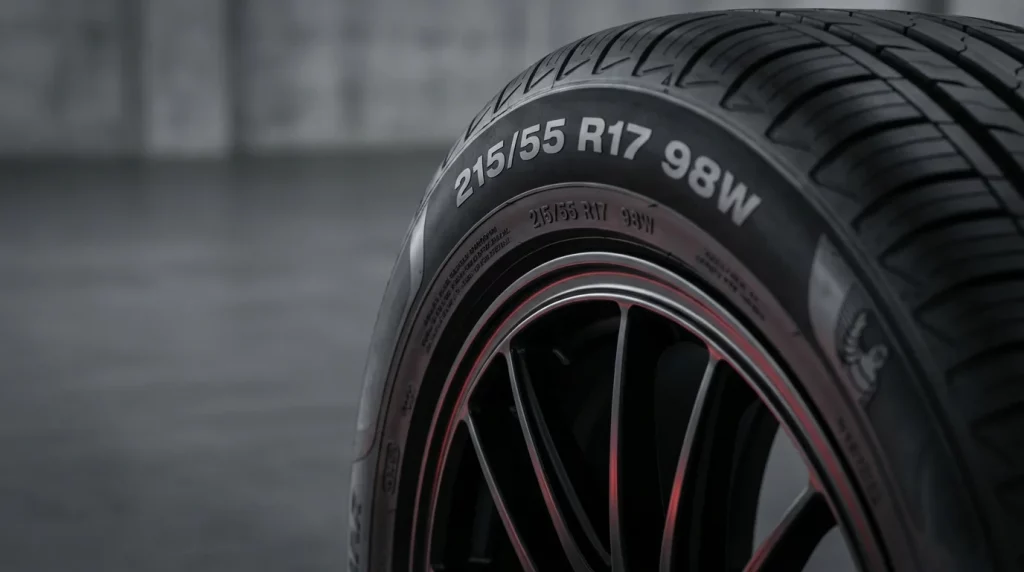
Here is the thing nobody tells you upfront: a tyre sidewall contains five or six separate codes, and most drivers have no idea what any of them mean. They squint at something like 205/55 R16 91V and either copy it blindly or guess. Both approaches can cost you real money.
This guide will make that string of numbers and letters completely readable in under ten minutes. By the end, you will know exactly what each number means, which ones matter most when ordering, which ones affect your safety, and what the tyre industry quietly hopes you never figure out on your own.
What Does a Tyre Size Actually Look Like on the Sidewall?
The standard tyre size format in the UK looks like this:
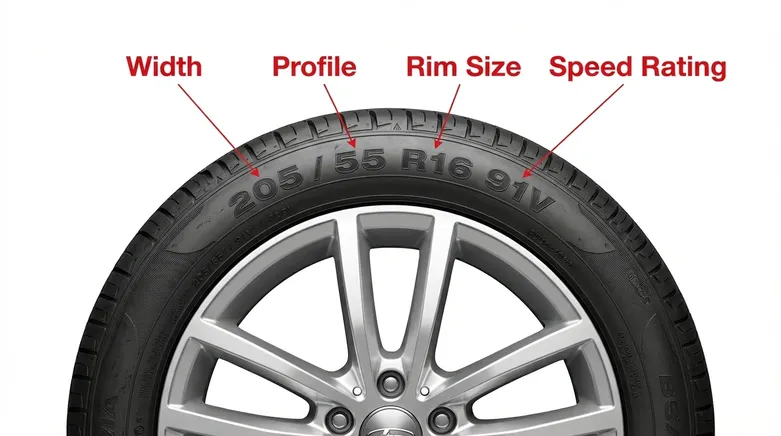
205 / 55 R16 91V
Every single part of that code tells you something specific. Think of it like a postcode for your tyre. Get one section wrong and you end up at completely the wrong destination. Let me break each section down properly, not in the dry textbook way, but in the way a fitter would explain it to you leaning against the van.
What Does the First Number Mean? (Tyre Width)
The first number 205 in our example is the tyre width in millimetres, measured across the tread from sidewall to sidewall.
This is the most important number for ordering. It tells you how wide your tyre is when mounted and inflated on the correct rim. In our example, 205 means the tyre is 205 millimetres wide.
Here is what surprises most people: this measurement is taken at the widest point of the inflated tyre, not the contact patch on the road. The actual footprint touching the tarmac is usually slightly narrower depending on the rim width you are fitting to.
Common widths you will see on UK cars range from 155mm on small city cars like the original Fiat 500 right up to 285mm or wider on performance SUVs and sports cars. Most family saloons and hatchbacks sit in the 195mm to 225mm range.
What happens if you get the width wrong?
Going 10mm wider than specified is a grey area some drivers do it intentionally for a wider stance and very slightly improved cornering grip. Going 20mm or more wider risks rubbing on the wheel arch, particularly on full suspension compression or sharp steering lock. Going narrower reduces road contact, affects braking distance, and can make the tyre sit improperly on the rim.
The manufacturer chose your tyre width for a very specific reason. It is not arbitrary. It balances ride comfort, braking performance, steering feel, and fuel efficiency for your exact vehicle weight and suspension geometry. Deviating from it is a choice with real consequences.
What Does the Second Number Mean? (Aspect Ratio / Profile)
The number after the slash 55 in our example is the aspect ratio. It tells you how tall the tyre sidewall is, expressed as a percentage of the tyre width.
So if your tyre is 205mm wide and has an aspect ratio of 55, the sidewall height is 55% of 205mm, which works out to approximately 112mm.
This is the number that causes the most confusion, and honestly, the most arguments in tyre fitting. Here is why.
A lower aspect ratio say 35 or 40 means a shorter, stiffer sidewall. You will find these on performance cars and sporty trims. They look great. Low-profile tyres give a sharper, more connected steering feel and reduce the squirm you get in corners. But the trade-off is brutal: they are significantly more vulnerable to pothole damage, they transmit every road imperfection directly into the cabin, and they cost considerably more to replace.
A higher aspect ratio say 65 or 70 gives you a taller, more cushioned sidewall. These are the tyres on your average family car, van, or SUV. More comfortable, better pothole resilience, cheaper to replace. Less sporty fee
Here is the insider knowledge most articles skip: the aspect ratio directly affects your speedometer accuracy and your ABS calibration. Your car’s electronic systems including the ABS, traction control, and speedometer are all calibrated around a specific overall tyre diameter. Change the aspect ratio significantly without adjusting the rim size to compensate, and your speedometer will read incorrectly. Your ABS may also behave differently than intended.
This is why fitting a 205/65 R16 where a 205/55 R16 is specified is not just an aesthetic choice it is a safety and legal one.
What Does the Letter R Mean? (Tyre Construction)
The R stands for Radial. It refers to how the internal cords of the tyre are constructed.
Virtually every passenger car tyre sold in the UK today is radial construction, so for most drivers reading this, you will always see R here. Radial means the internal cords run perpendicular to the direction of travel, which gives excellent flexibility, fuel efficiency, and heat dissipation.
You will occasionally see the letter D instead, which stands for Diagonal or Bias-ply construction. These are found on older vehicles, some trailers, and certain off-road or agricultural tyres. If your car requires radial tyres and you fit diagonal construction, you will feel it in every corner. Do not do it.
There is also RF, which stands for Run Flat. This tells you the tyre has reinforced sidewalls that can support the vehicle for a limited distance even with zero air pressure. More on run flats in a moment, because this is where things get genuinely interesting.
What Does the Third Number Mean? (Rim Diameter)
The number after R 16 in our example is the rim diameter in inches. It tells you what size wheel the tyre is designed to fit.
Note that unlike the width and profile measurements which are in millimetres, the rim diameter is in inches. This is a historical quirk of the tyre industry that has never been corrected and causes endless confusion for people approaching tyre specs for the first time.
Your rim size must match exactly. A tyre marked R16 will only fit a 16-inch rim. It will not stretch onto a 17-inch rim, and it will not stay seated properly on a 15-inch rim. This is non-negotiable.
Common rim sizes on UK cars run from 13 inches on older small cars to 22 inches and beyond on premium SUVs. In recent years, manufacturers have been upsizing rims significantly partly for aesthetics, partly because larger diameter brakes fit better behind larger rims. This is directly related to why average tyre costs have risen: larger rims require larger, more expensive tyres with lower profiles to maintain the correct overall diameter.
What Do the Final Numbers and Letter Mean? (Load Index and Speed Rating)
The final two elements 91V in our example are the load index and speed rating. These are arguably the most safety-critical numbers on the entire sidewall, and they are the ones most drivers completely ignore.
Load Index – the Number
The load index tells you the maximum weight each tyre can support when properly inflated. 91 in our example corresponds to 615 kilograms per tyre. With four tyres, that gives a total load capacity of 2,460kg for the vehicle.
Here is the critical part: you must never fit a tyre with a lower load index than your vehicle manufacturer specifies.
Your car has a kerb weight, and when you add passengers, fuel, luggage, and a roof box, the total can approach or exceed the tyre’s load capacity surprisingly quickly.
A common load index table for reference:
Load Index | (kg) |
|---|---|
82 | 475 kg |
87 | 545 kg |
91 | 615 kg |
95 | 690 kg |
99 | 775 kg |
103 | 875 kg |
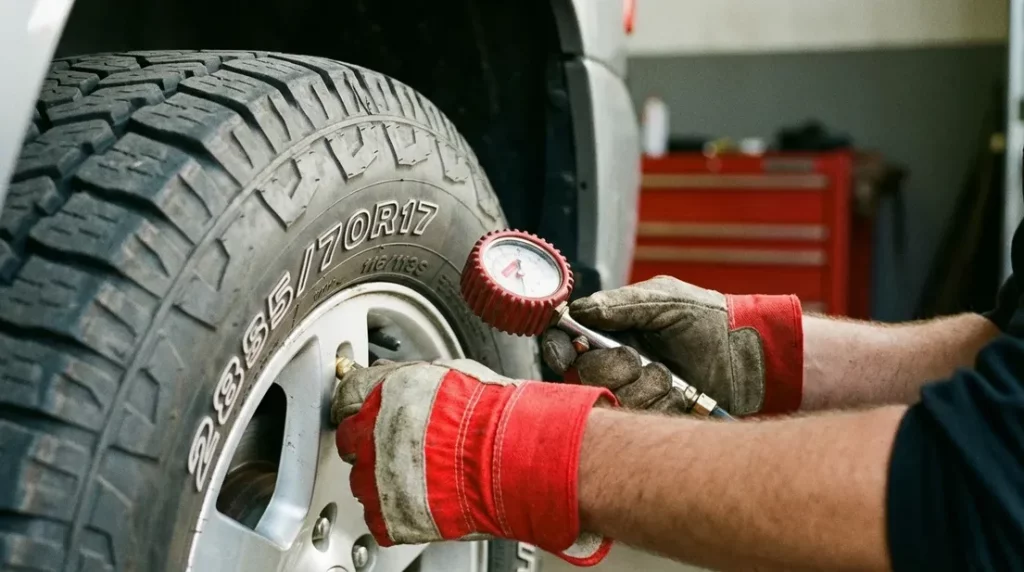
Most family cars sit between 87 and 95. Check your vehicle handbook or door sill sticker for your exact requirement.
Speed Rating – the Letter
The letter after the load index is the speed rating. It tells you the maximum sustained speed the tyre is tested and approved for.
Letter | Speed Rating |
|---|---|
T | 190 km/h (118 mph) |
H | 210 km/h (130 mph) |
V | 240 km/h (149 mph) |
W | 270 km/h (168 mph) |
Y | 300 km/h (186 mph) |
For most UK driving, a T or H rated tyre is perfectly adequate given the motorway limit is 70mph. However and this is important you must never fit a tyre with a lower speed rating than your manufacturer specifies. Fitting an T-rated tyre on a car that requires a V-rated tyre is illegal and invalidates your insurance. The tyre may fail at speeds the car is capable of reaching.
Going higher than specified is always fine. Fitting a W-rated tyre where a V is required is no problem at all.
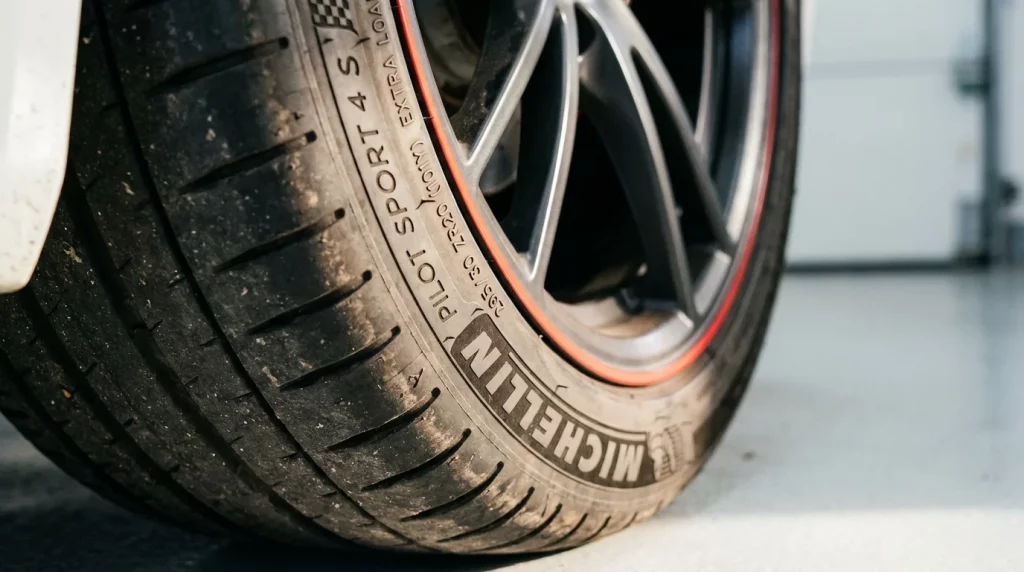
Where Exactly on the Sidewall Do You Find All This?
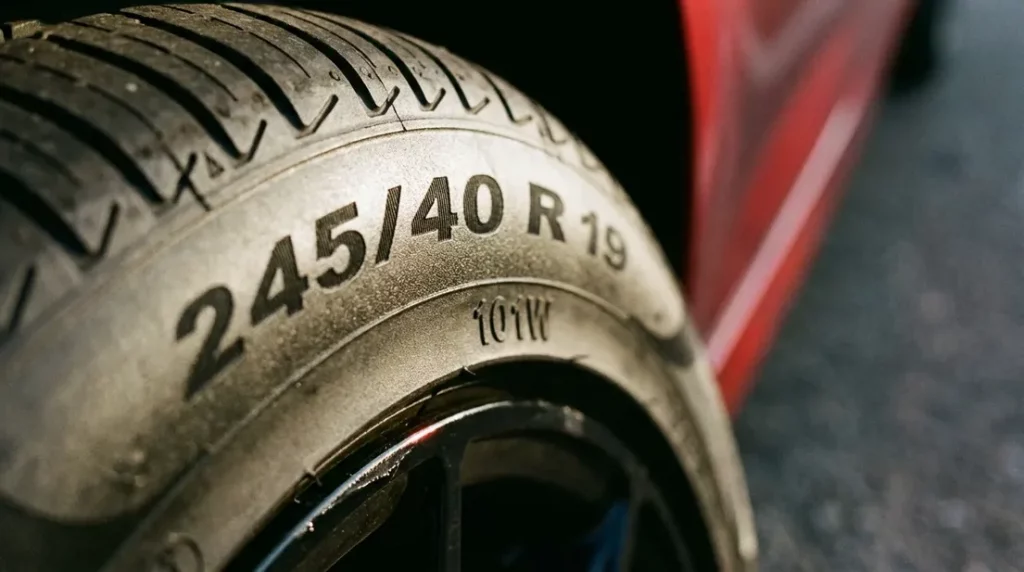
The full size code is moulded into the sidewall in raised letters, typically on the outer-facing side of the tyre. On most modern tyres it appears near the rim edge, not in the middle of the sidewall.
You are looking for a sequence that follows this pattern: three digits, a slash, two digits, a letter, two digits, two digits, a letter. Once you see it once, you will recognise it instantly every time.
Do not confuse it with other codes on the sidewall. There is also a DOT code (a manufacturing date and origin code beginning with the letters DOT), a treadwear indicator number, and sometimes a traction and temperature rating. These are separate from the size code and serve different purposes.
The DOT code is worth knowing about. The last four digits of the DOT code tell you the week and year the tyre was manufactured. For example, 1423 means week 14 of 2023. Tyres degrade over time regardless of tread depth. Most manufacturers and the British Tyre Manufacturers Association recommend replacing tyres over six years old, and tyres over ten years old should be replaced regardless of how they look. You will never see this advice printed on a price sticker.
Common Tyre Size Mistakes and How to Avoid Them
Mistake 1: Copying the rim size only.
Some drivers see the 16 or 17 and think that is the tyre size. It is not. You need the full sequence.
Mistake 2: Assuming all four tyres are the same size.
Some performance vehicles particularly rear-wheel drive sports cars run a wider tyre on the rear axle than the front. Always check all four tyres individually before ordering.
Mistake 3: Ignoring the load index when buying budget tyres.
Some budget tyre sellers list tyres without clearly showing the load index. Always check the full specification matches your vehicle requirement, not just the width, profile, and rim size.
Mistake 4: Mixing speed ratings across the axle.
If you need to fit two new tyres, the two tyres on the same axle should have matching speed ratings. Mixing ratings can cause uneven braking behaviour.
Frequently Asked Questions
A tyre sidewall tells you more about your safety than almost any other piece of information on your car. That string of numbers and letters is not technical noise it is a safety specification that engineers spent significant time calculating for your exact vehicle.
The customer who called us furious about the wrong tyres? He laughed about it afterwards. “I looked at it for years and never once thought to learn what it meant,” he said. Now he checks every tyre himself before any order goes in.
That is exactly where you are now. Next time you crouch beside your car and look at that sidewall, you will read it like a road sign instantly, confidently, and correctly.
If you are not sure whether your current tyres match your vehicle specification, we can check for you when we come to fit. Book a mobile tyre fitting and we will confirm your full tyre spec on arrival before we start any work.
What is one thing about your tyres you have always wondered but never got around to asking? Drop it in the comments we answer every single one.